The Triangle is growing fast. Not every neighbor is growing with us.
The four counties that make up the Triangle, Wake, Durham, Orange, and Johnston, draw new residents and new employers year after year. We rank among the most sought-after places to live, and our economy continues to outpace most of the rest of the country.
Source: U.S. News & World Report, 2025–2026.
Durham
Raleigh
Source: Geography of Prosperity Index, 2026.
Source: U.S. Census Bureau, 2024–2025.
Behind the rankings is a different picture. One in three households across our four counties can't cover the basic cost of living. That is about 264,000 households. Most are ALICE: Asset Limited, Income Constrained, Employed. They earn more than the federal poverty line but less than what it costs to live here. They are child care workers, cashiers, home health aides, and delivery drivers, the people who keep our region running.
The region's 800,450 households
About 69,100 households
About 195,100 households
About 536,200 households
across our four counties can't cover the basic cost of living
of single mothers in Johnston County are below the ALICE threshold, the highest rate in our region
households across four counties are below the ALICE threshold
Source: United For ALICE, 2024. Household counts are estimates.
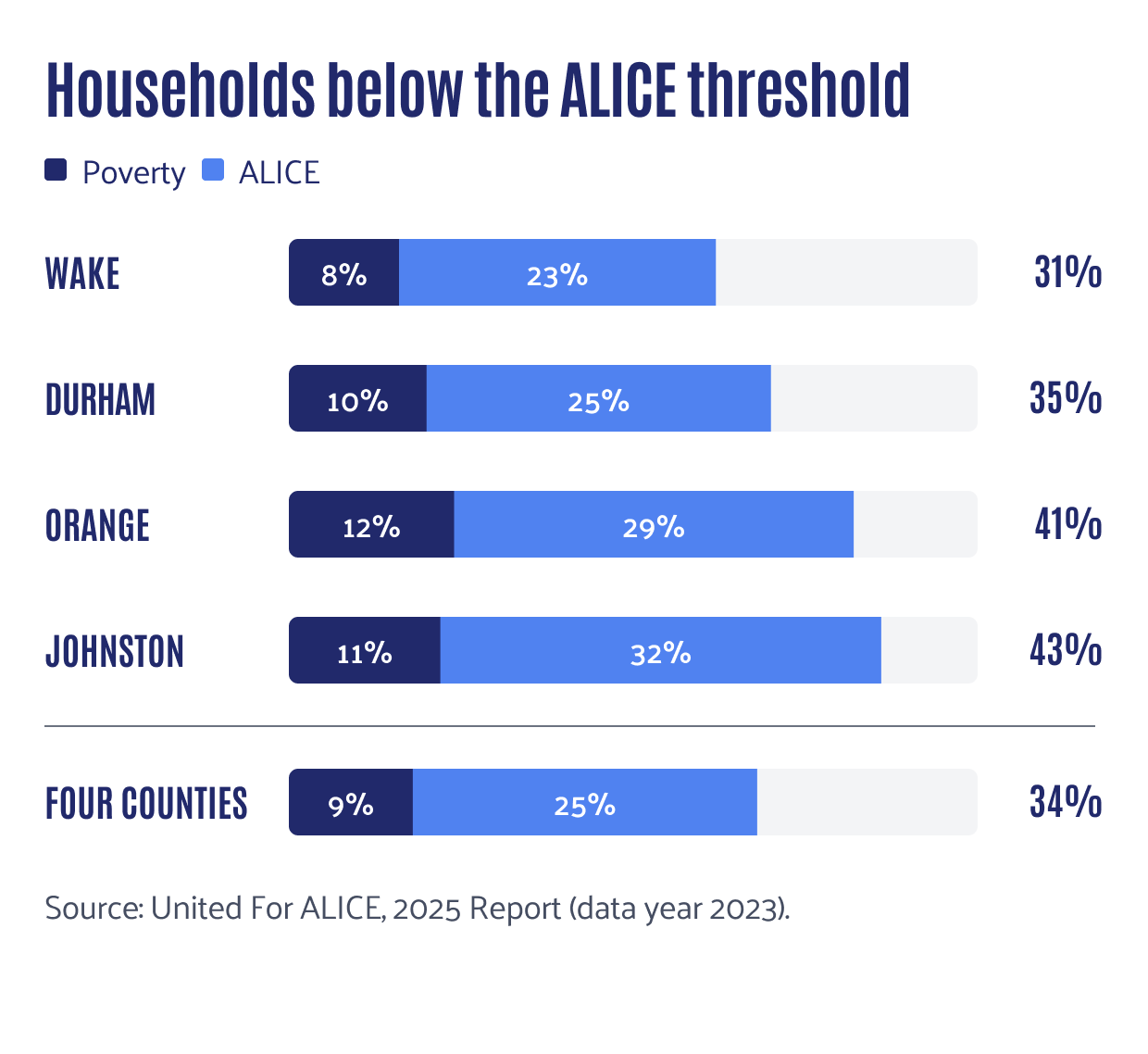
Across the four counties, 34% of households fall below the ALICE threshold. That includes 9% in poverty and 25% who are Asset Limited, Income Constrained, Employed (ALICE). ALICE households are working, but their income is too low to afford the basics. They are distinct from households in poverty, which are below the federal poverty line.
share below the ALICE threshold
households across the four counties
| Poverty | ALICE | ||
|---|---|---|---|
| Wake | 8% | 23% | 31% |
| DURHAM | 10% | 25% | 35% |
| ORANGE | 12% | 29% | 41% |
| JOHNSTON | 11% | 32% | 43% |
| Four counties | 9% | 25% | 34% |
Source: United For ALICE, 2025 Report (data year 2023).
United Way Greater Triangle's mission is to eradicate poverty and increase social mobility through the power of partnerships, with support provided across Durham, Johnston, Orange, and Wake counties. Through its three impact focus areas (Cradle to Career, Healthy Families, and Equity in Leadership), United Way supports 91 nonprofit organizations, collaboratives, and leaders doing the on-the-ground work needed to break the cycle of poverty.

We invest in community-driven solutions, convene the partners who can move them forward, and amplify what's working. We serve the nonprofits and community leaders building those solutions on the ground. We also serve the residents, donors, and business leaders ready to be part of a region-wide shift toward shared prosperity.
Think of us as the plus sign. When one dollar of funding meets one dollar of aligned effort, the result can be three, four, or five dollars of community impact. That multiplier is what United Way is for. We are the connector that turns separate, well-meaning work into shared, sustained progress.
ALICE looks different in each of our counties. In one, the biggest gap is pay. In another, it's the cost of child care. Choose a county to see its picture.
The poverty line is about a third of what the basics cost here, so a lot of ALICE households qualify for little help.
Benefits like child care and food assistance can fall away faster than wages grow, so a raise can leave a family worse off.
Employers, colleges, public agencies, and nonprofits each invest in part of the picture, and the connections between them can fall through the cracks.
Align your giving, your people, and your presence with the work that moves our neighbors forward.
Every dollar you give moves a household closer to thriving across our four counties.
30% of households, about 150,000, are below the ALICE threshold. Wake has the highest incomes in our region and the largest number of households below the threshold, more than the other three counties combined.
35% of households, about 51,800, are below the ALICE threshold. One in three households is working and still short. 68% of single mothers and 61% of single fathers are below the threshold.
47% of households, about 28,400, are below the ALICE threshold, the highest share in our region. Child care for one young child costs about $1,670 a month.
37% of households, about 34,100, are below the ALICE threshold. Many are working families just above poverty. 79% of single mothers are below the threshold, the highest rate in our region.